

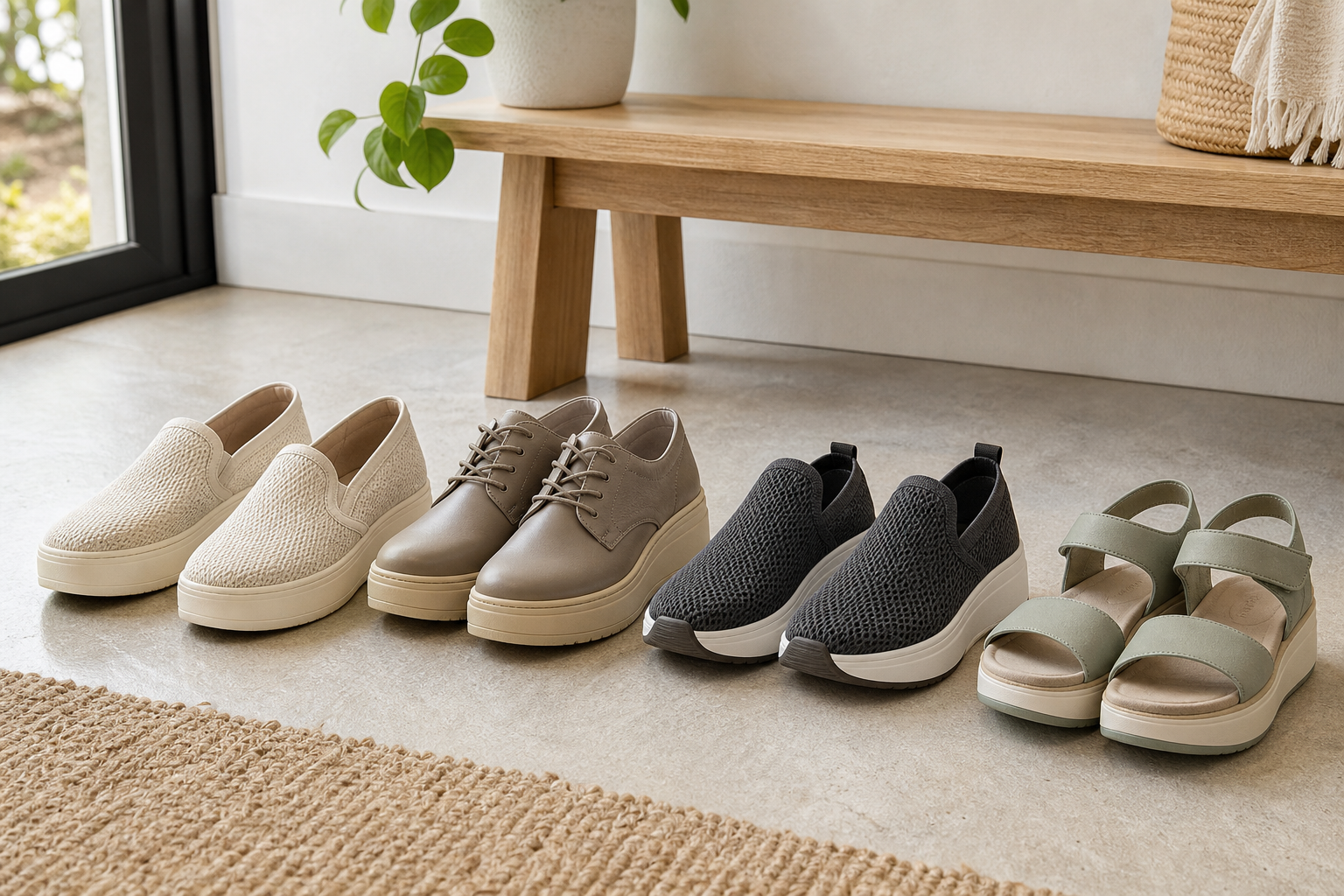
The short answer: choose slip-on platform shoes when quick on-and-off convenience matters and the upper holds your foot securely; choose lace-up platforms when you want more adjustment across the instep; choose mesh platforms when airflow and a lighter-feeling upper suit the setting; and choose platform sandals when open coverage matches the weather and activity. No construction is automatically the most stable, comfortable or slip-resistant—the right choice depends on fit, platform geometry, surface and intended use.
Platform shoes raise much or all of the foot above the ground. That can change how a shoe feels during turns, curbs and uneven transitions. Before buying, compare the current size chart and product details, then test a new pair indoors on a clean, dry surface while it remains eligible under the store's return policy. Persistent pain, numbness or balance concerns call for individualized advice from a qualified health professional rather than a general footwear guide.
Platform shoe styles at a glance
| Style | Best starting point | Fit check | Use-case caution |
|---|---|---|---|
| Slip-on platform | Fast, uncomplicated entry | Heel stays with the shoe without toe gripping | A loose opening can let the foot shift |
| Lace-up or Derby platform | Adjustability across the instep | Laces secure the foot without pressure or numbness | Loose laces create a trip hazard |
| Mesh slip-on platform | More open upper construction | Mesh supports without digging or excessive stretch | Open mesh is not weatherproof or protective |
| Platform sandal | Warm-weather openness | Straps hold the foot without rubbing; toes stay on the footbed | Open toes offer less coverage from debris and impact |
Start with platform geometry, not just height
Two shoes with a similar-looking platform can behave differently. Inspect the height at the heel and forefoot, the width of the outsole, the transition from heel to toe and where the sole flexes. A broad base may feel different from a tapered shape, but appearance alone does not prove stability. Product photos also cannot show exactly how a shoe interacts with your foot or walking pattern.
Place both shoes on a level surface before wearing them. They should sit evenly without obvious rocking, distortion or damage. During an indoor test, take ordinary steps, stop, turn and step across a low threshold. If the shoe tilts unexpectedly, your heel repeatedly lifts, or you must alter your natural stride to keep it on, reconsider the size or style.
Slip-on platforms: convenience depends on retention
The active Comfy Slip-On Platform Shoes are a useful catalog example when you prefer an enclosed shoe without laces. For any slip-on, the opening and upper have to do the work that laces would otherwise do. Confirm that the current materials, colour, measurements and size guidance match your needs on the live product page.
A good initial fit keeps the broadest part of the foot aligned with the broadest part of the shoe. Toes should not press the front, and the heel should not rise dramatically with every step. A small amount of movement can occur depending on construction, but repeated sliding or toe curling suggests poor retention. Do not solve a fundamentally loose fit by assuming a thick sock will always make it appropriate.
Lace-up platforms: adjust from the toe upward
A lace-up style such as the Comfy Casual Derby Platform Shoes gives you more control over upper tension. Begin with the laces loose, seat the heel at the back and tighten gradually from the lower eyelets upward. The goal is even hold, not maximum tightness.
Stand and walk for several minutes. Watch for tingling, pressure lines, heel slip or an instep that feels compressed. Secure the bow so loops do not drag, and replace frayed laces. A lace-up closure can improve adjustability, but it cannot compensate for the wrong length, width or platform shape.
Mesh platforms: ventilation is not the same as all-weather performance
The Comfy Slip-On Double Mesh Platform Shoes represent a more open upper construction. Mesh may allow more airflow than a solid upper, but results depend on the weave, lining, socks and weather. Check the current product specifications instead of assuming all mesh behaves the same way.
Look for bunching, overstretching or concentrated pressure around seams and the opening. Fine debris and moisture may pass through some meshes, so choose a different style when the setting requires more coverage. Mesh also does not guarantee a lighter outsole, cushioning, water resistance or faster drying unless the product information specifically supports those features.
Platform sandals: check straps, footbed and exposed edges
For warmer conditions, compare the current details of the Comfy Slip-On Flat Platform Sandal. Your heel and toes should remain within the footbed rather than hanging over its edges. Straps should hold the foot without pinching or producing hot spots during a short indoor test.
Open footwear exposes skin to sun, contact and debris. It may not suit long walks, rough ground, work settings or activities that require enclosed toes. A platform sandal should never be treated as a substitute for purpose-specific hiking, water, safety or athletic footwear.
How to measure and test the fit
- Measure both feet. Use the store's current measuring method and compare the larger foot with the product chart.
- Wear your planned socks. Socks can change volume and how the upper feels.
- Check length and width while standing. Make sure no edge cuts into the foot and no toe sits beyond the footbed.
- Walk, stop and turn indoors. Notice heel lift, side-to-side movement, rubbing and whether the platform lands predictably.
- Inspect the outsole and construction. Look for damage, uneven attachment or wear before every use.
Foot size and shape can change over time, and two feet are often not identical. A familiar numeric size is only a starting point. If a product page uses a different region's sizing system, rely on its current conversion guidance rather than guessing from the label.
Match the shoe to the surface and occasion
For dry indoor errands or casual social settings, a well-fitting slip-on or lace-up platform may be practical. Mesh can suit dry, mild conditions when openness is welcome. Sandals can suit relaxed warm-weather use where open toes are appropriate. For rain, ice, loose gravel, steep slopes or long distances, reassess whether a raised platform is the right tool at all.
No outsole is slip-proof. Water, dust, oil, worn tread and surface materials all affect traction. In Canadian seasonal conditions, keep a weather-appropriate alternative available and check local conditions before leaving. Use handrails on stairs, slow down at transitions and avoid wearing damaged footwear.
Care helps preserve the intended shape
Follow the care directions for the exact upper and sole materials. Brush off loose dirt, spot-clean only with compatible products and air-dry away from direct high heat unless the manufacturer says otherwise. Saturating a bonded platform or placing it near a heater can affect some materials and adhesives.
Store pairs on a level surface rather than crushed under heavier items. Before wearing them again, inspect the upper attachment, seams, laces, straps and outsole. Retire or professionally assess shoes with separation, deep wear, persistent rocking or structural damage.
Frequently asked questions
Are lace-up platform shoes more stable than slip-ons?
Not automatically. Laces provide adjustability, but overall stability also depends on fit, outsole geometry, platform height, walking surface and the wearer. Compare the complete shoe and perform a careful indoor fit test.
Are mesh platform shoes good for summer?
They can be a practical option when you prefer a more open upper in dry, mild weather. Mesh does not guarantee cooling, water resistance or suitability for every outdoor activity.
Should I size up in platform shoes?
Use the current product chart and measurements rather than a blanket sizing rule. Sizing up unnecessarily may create movement, while sizing down may cause pressure. Check both length and width.
Can platform shoes be worn all day?
Wear time is individual and depends on fit, activity and setting. Break in new shoes gradually, alternate styles when useful and stop if pain, numbness, instability or skin irritation develops.
Do platform soles provide guaranteed traction?
No. Tread design is only one factor, and traction changes with contamination, wear, weather and the walking surface. Use caution and choose footwear intended for the actual conditions.
Bottom line
Choose among slip-on, lace-up, mesh and sandal platforms by answering four questions: does the shoe retain your foot, can you adjust it appropriately, does its coverage suit the setting, and does the platform feel predictable during a real indoor walking test? Use current product specifications and sizing information, not assumptions about style names. A secure fit and realistic use case matter more than unsupported comfort, stability or traction promises.