

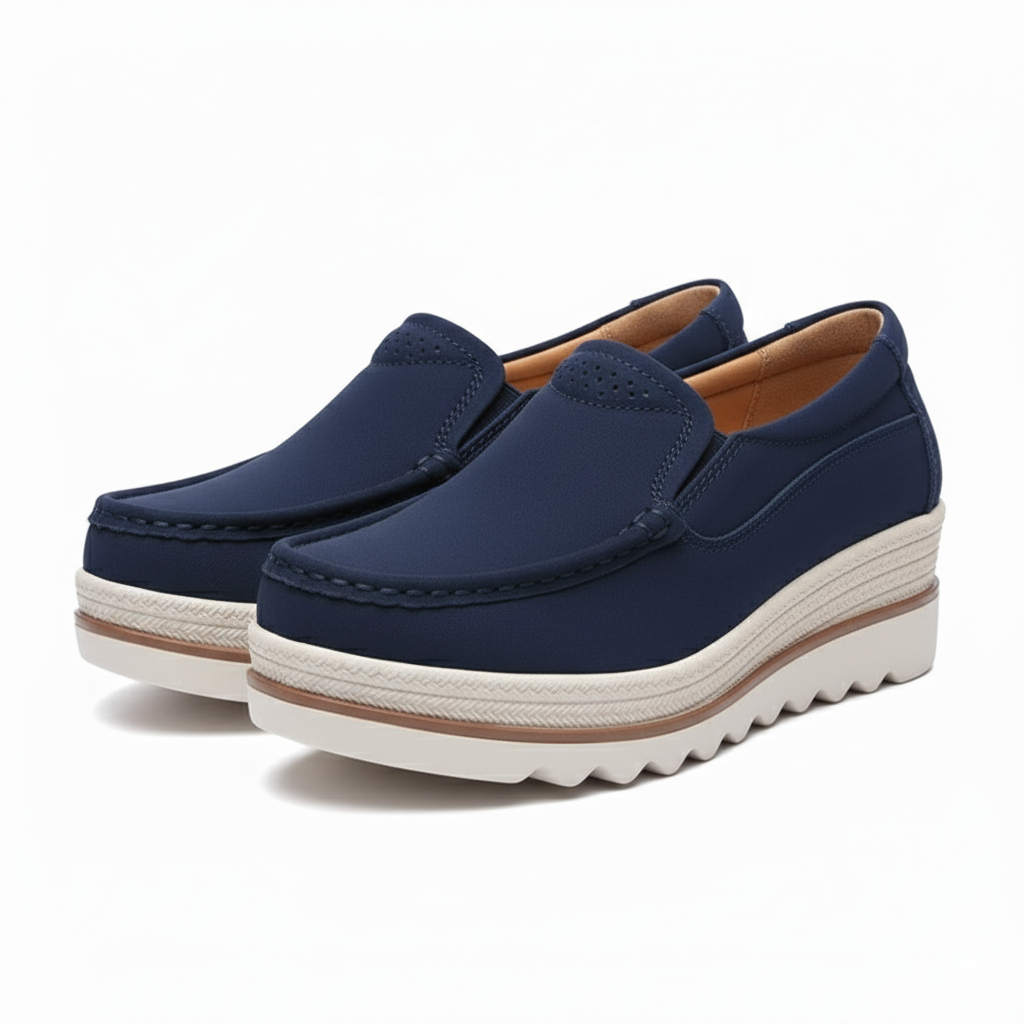
The most useful shoe-sizing question includes the exact product, your measurements and the fit problem you are trying to avoid. “I normally wear a size eight—will these fit?” leaves important details out, especially when switching between slip-on, lace-up and mesh platform shoes.
If September means buying footwear for a changed routine, prepare one clear message before ordering. It can help customer support answer a specific question without turning an email exchange into repeated guesses. No remote response can guarantee comfort, but good information makes the conversation more useful.
Name the shoe, not just the store
Send the product link and selected option. The Comfy Slip-On Platform Shoes and Comfy Casual Derby Platform Shoes are different styles. An answer about one should not silently become sizing advice for the other.
Include the size system shown on the listing. If a chart gives centimeters while your familiar size is expressed in another system, ask how the chart is intended to be read rather than choosing the nearest-looking number.
A screenshot of the relevant chart can clarify which information you saw. Keep the product name visible so it cannot be confused with another page.
Measure using the listing's method
Follow any measurement directions on the product page. If the chart does not explain whether a number represents foot length, insole length or another dimension, that is a useful question to ask.
Record the units and measure both feet. Do not add an arbitrary amount of “extra space” and present that adjusted figure as your actual foot measurement. Give the original number and ask how it relates to the chart.
For example: “My measured foot length is X centimeters using your stated method. Does the listed Y measurement refer to the foot or the shoe?” Replace X and Y with your real figures when writing to support; there is no universal number to fill in here.
Explain the practical fit concern
Tell support whether the concern is the opening, instep, toe space or adjustment. “Slip-ons usually feel loose at my heel” describes a different problem from “I need more room over the top of my foot.”
Mention the socks you plan to wear, without assuming that thicker socks will fix an unsuitable shoe. If you have a foot condition or use prescribed devices, seek individualized professional advice rather than asking a retail team to diagnose fit or recommend treatment.
Our existing slip-on, lace-up and mesh platform comparison explains why closure style is a separate consideration from the printed size.
Ask about the next step if the fit is wrong
Read the current return policy before purchasing. Ask what conditions apply to indoor try-ons, packaging and the selected product. Do not assume that every style or promotion has identical terms.
Save the response with your order information. When the shoes arrive, compare the received label and option with the order before wearing them outside. If something differs, document it and contact the store rather than trying to make the wrong item work.
A message you can adapt
“I am considering [product link] in [option]. My measurements are [figures and units], taken using [method]. I usually have difficulty with [specific fit issue] and plan to wear [sock type]. Which chart measurement should I compare, and what are the current try-on and return conditions?”
That message gives the seller a clear starting point. It also leaves you with a better record of the decision than a hurried purchase based only on a familiar size number.